
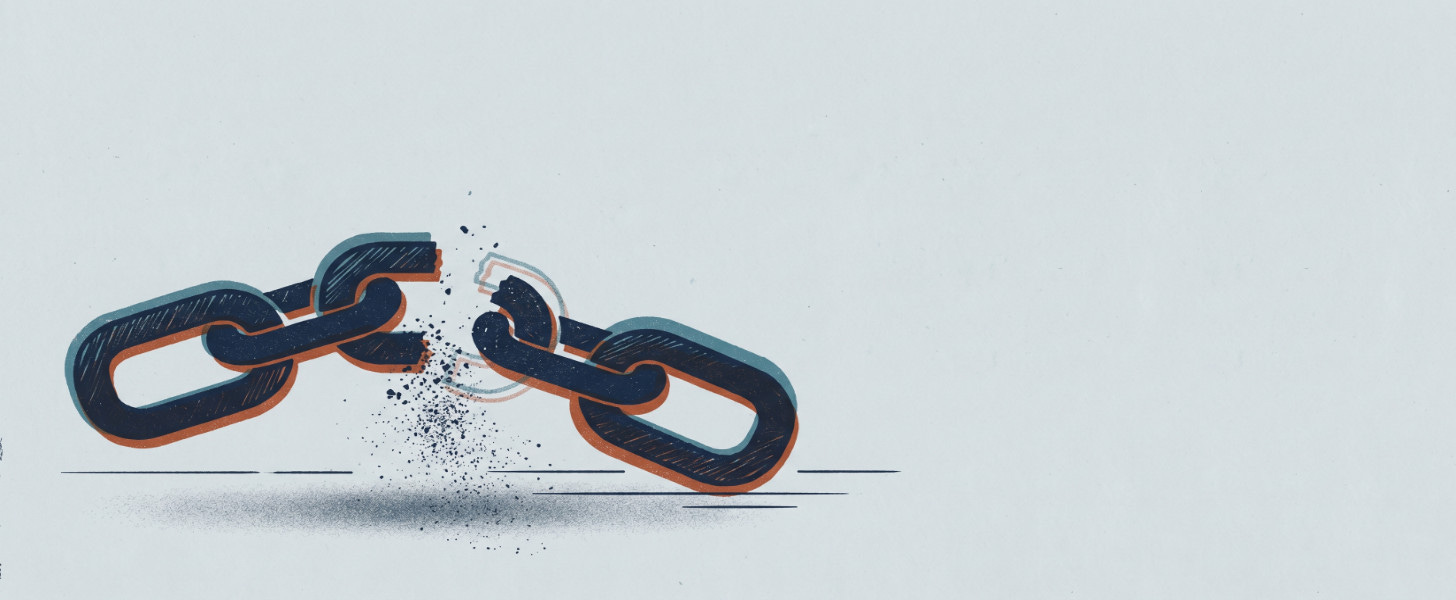
A country can disappear from the internet. It has already happened.
A country can vanish from the internet without war. One OFAC sanction, one RSP compliance decision, one criminal case. The .iq and .yu cases prove it's already happened.

Yugoslavia no longer exists. Neither does its domain, .yu.
The Soviet Union dissolved in 1991. Its domain, .su, lives on.
Iraq still exists. But a single federal criminal case — Hamas financing charges, Texas, 2002 — was enough to paralyze .iq, Iraq’s entire internet namespace, for years.
The real danger is not a country vanishing from the map. It is a country that is perfectly fine — and gets erased from the internet anyway.
Because the weak point is not geopolitics. It is a bad contract, an operator subject to a foreign jurisdiction, or a court ruling from another country.
The next ccTLD crisis will not come from a country breaking apart.
It will come from a Registry, a foreign Registry Services Provider (RSP), or a TLD nameserver operator — headquartered somewhere near Washington, London, or Brussels.
One morning, updated OFAC, OFSI, or EU sanctions guidance lands, and suspending a national namespace becomes that operator’s safest legal option. No war. No dissolved country. No ICANN resolution — just a contractual decision, taken under legal pressure, that can be executed in hours.
In 2022, this nearly happened — at significant scale.
Ukraine’s Deputy Prime Minister asked ICANN to remove .ru, .su, and .рф from the DNS root zone. ICANN declined the request, stating that it had neither the mandate nor the authority to impose sanctions.
But what about the actors deeper in the contractual chain? ICANN has no authority over them either.
Switzerland-based SITA — operator of the .aero TLD — refused to renew approximately 400 .aero domains registered by Russian organizations. Why? Because the actual contracting entity was a US-based subsidiary operating under OFAC jurisdiction. The DNS root zone remained intact. The domains disappeared anyway.
The real risk is not in the IANA delegation, and not in the root zone. It is in the underlying operational contracts.
Many small and mid-sized countries run their national domains on American or British infrastructure — under contracts that include governing law clauses and sanctions compliance obligations.
The naming right belongs to the country — the IANA delegation. The technology belongs to a foreign company — the database, the DNS servers.
.sk is the textbook example of this structure. The IANA-delegated operator, SK-NIC, a.s., is a Bratislava-registered company; since 2017 it has been owned by Team Internet Group, a British firm listed on London’s AIM market. The naming right stays with Slovakia; the company that runs the namespace answers to a foreign parent under foreign law.
The .co ccTLD follows the same pattern. Since October 2025, after a MinTIC tender, Colombia’s ccTLD has been run by a consortium of the London-listed Team Internet Group and a Colombian partner. Again: the naming right is national, the operating company sits under a foreign jurisdiction.
That separation — a national naming right resting on foreign-jurisdiction infrastructure — is the structural risk.
Wherever it exists, a sanctions instruction — or a compliance decision an operator has little room to refuse — can take the technical infrastructure of a national namespace offline in hours, before the local IANA delegate can even find a lawyer.
OFAC formally exempts domain registration services, but Iraq required no new regulation. A single federal criminal case was enough to take an entire country’s namespace offline for more than two years.
The national operators who understood this have already acted: they run their own software, keep infrastructure under their own control, and contract with providers outside sanctions jurisdiction.
The rest are sitting inside someone else’s compliance framework.
Exposed.
No war required. A compliance letter will do.
Magyar változat: [zona.hu/egy-teljes-orszag-eltunhet-az-internetrol]